

In questo terzo articolo, vedremo lo schema logico dell’orologio e due componenti fondamentali: il real time clock per mantenere l’orario e l’expander per avere a disposizione più linee di I/O.
Schema logico
Vediamo i componenti fondamentali dell’orologio:
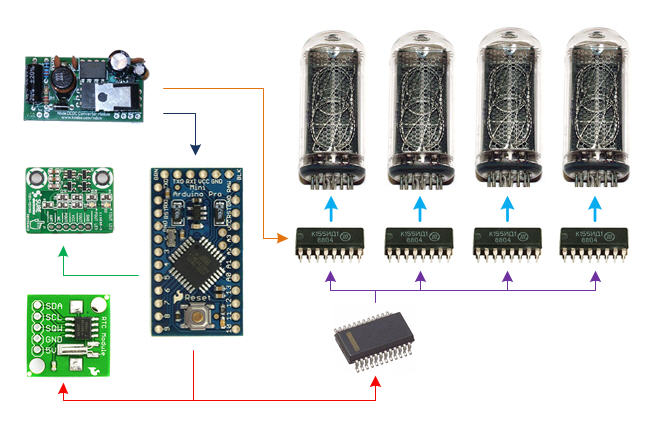
[checklist]
- Un modulo alimentazione con uscite 5V (per la logica) e 170V (per le Nixie);
- un Arduino Mini per coordinare i vari elementi;
- un modulo per la gestione di contatti a sfioramento (argomento di un prossimo post);
- un modulo RTC connesso via bus I2C;
- un integrato per espandere il numero di porte I/O, anch’esso via I2C;
- quattro integrati 74141 per il controllo delle Nixie;
- quattro tubi Nixie ZM1177.
[/checklist]
Di seguito vedremo in dettaglio due di questi elementi…


I get :error:
PCF8575_Led_rolling_Demo.cpp: In function ‘void loop()’:
PCF8575_Led_rolling_Demo.cpp:24:8: error: ‘class TwoWire’ has no member named ‘write’
PCF8575_Led_rolling_Demo.cpp:25:8: error: ‘class TwoWire’ has no member named ‘write’
I able to compile by change it for
Wire.write(low);
Wire.write(high);
to
Wire.send(low);
Wire.send(high);
but still now a blink from any of the LED’s. Are you using any resistor? I”ve tryed it using just the pcf8575 anf an arduino board, no RTC module. Is that doable and if so what I’m I doing wrong?
Hi
You’re probably using an older (< 1.0) version of Arduino IDE... anyway you don't need a RTC module for this example, could you post your connections so I can check?
Cool demo. I have some questions http://arduino.cc/forum/index.php/topic,100097.msg750764.html#msg750764
Hello!
I’m trying to build a circuit with a RTC and a PCF8575 .
It happens that the RTC does not tell the correct time.
There must be some conflict.
The code I’m using to test is this:
[…]
The code does not appear correctly.
Here’s a link to it.
https://gist.github.com/21dfdc057cfbd1cc44a9/5e7c42002b4025b9d48a21896d81c9a6bd74cbba
Best regards.
Hi Fernando,
are you using an Arduino Mega?
Hello Luca.
Thanx for your manual!
Could you advise IO extender on 24 pins (for 6 tubes)?
I’ve found the Tca6424rgjr but probably there is something better.
Hi Dmitry… it depends on you: on the I2C bus you can connect more than one expander, therefore you can use 3 8-pins expanders or the one you found that works fine!
Hi, where i can read more about power supply ?
Thx.
Hi, please see this blog post -> http://www.lucadentella.it/2011/11/20/orologio-nixie-1-lalimentatore/
Ciao Luca,
non riesco a compilare NESSUN esempio che utilizza il pcf8575!
Ho scaricato le librerie da github le istallo ma gli esempi Blinkled non si compilano . dice che manca il file PCG8575.h.
Ho cercato altre libreria MA IN TUTTO L’UNIVERSO ESISTONO SOLO QUELLE SU GITHUB CHE NON FUNZIONANO !!
Dove sbaglio ?
Devo usare tre 8575 in I2C e collegare ai pin digitali 2 e 3 di Arduino Nano il modulo Bluetooth HC-06 .
Le librerie 8575.h e SoftwareSerial.h sembra che non possano convivere assieme.
Con qualsiasi IDE con cui cerco di compilare mi da sempre:
SoftwareSerial\SoftwareSerial.cpp.o: In function `__vector_3′:
\\Srv01\dati\Comune\Arduino\IDE_ARDUINO\arduino-1.5.8\hardware\arduino\avr\libraries\SoftwareSerial/SoftwareSerial.cpp:306: multiple definition of `__vector_3′
PCF8575\PCF8575.cpp.o:\\Srv01\dati\Comune\Arduino\IDE_ARDUINO\arduino-1.5.8\libraries\PCF8575/PCint.h:104: first defined here
SoftwareSerial\SoftwareSerial.cpp.o: In function `__vector_4′:
\\Srv01\dati\Comune\Arduino\IDE_ARDUINO\arduino-1.5.8\hardware\arduino\avr\libraries\SoftwareSerial/SoftwareSerial.cpp:313: multiple definition of `__vector_4′
PCF8575\PCF8575.cpp.o:\\Srv01\dati\Comune\Arduino\IDE_ARDUINO\arduino-1.5.8\libraries\PCF8575/PCint.h:107: first defined here
SoftwareSerial\SoftwareSerial.cpp.o: In function `__vector_5′:
\\Srv01\dati\Comune\Arduino\IDE_ARDUINO\arduino-1.5.8\hardware\arduino\avr\libraries\SoftwareSerial/SoftwareSerial.cpp:320: multiple definition of `__vector_5′
PCF8575\PCF8575.cpp.o:\\Srv01\dati\Comune\Arduino\IDE_ARDUINO\arduino-1.5.8\libraries\PCF8575/PCint.h:110: first defined here
collect2: error: ld returned 1 exit status
Errore durante la compilazione